 blog
How to Choose Local vs National Restoration
Last Updated: October 24, 2026
Quick Summary
The local vs national restoration choice matters less than who can physically reach your property first, knows your insurance market, and stays accountable through the rebuild. Local firms often arrive faster and communicate directly, while national chains offer scale and carrier relationships during widespread events.
- Ask every restoration company for a guaranteed arrival window in writing, not a vague promise.
- Local firms have finite crews, so widespread storms can stretch their capacity thin.
- National chains may hold preferred-vendor agreements that simplify approval for large commercial losses.
- Confirm whether the company handles the rebuild or if you need separate contractors.
- Disaster Services offers 24/7 emergency response and a free visual inspection in Greater Houston.
Table of Contents
- Local vs National Restoration: Which Responds Faster After a Disaster?
- How to Choose a Restoration Company That Fits Your Property and Claim
- Local Restoration Companies: Strengths and Trade-Offs
- National Restoration Chains: Strengths and Trade-Offs
- Restoration Company Response Time: What the First Few Hours Decide
- Questions to Ask a Restoration Company Before You Sign
- Restoration Company Insurance Claims: Who Handles the Paperwork
- Schedule Your Free Inspection With a Local Restoration Team
- Frequently Asked Questions
Local vs National Restoration: Which Responds Faster After a Disaster?
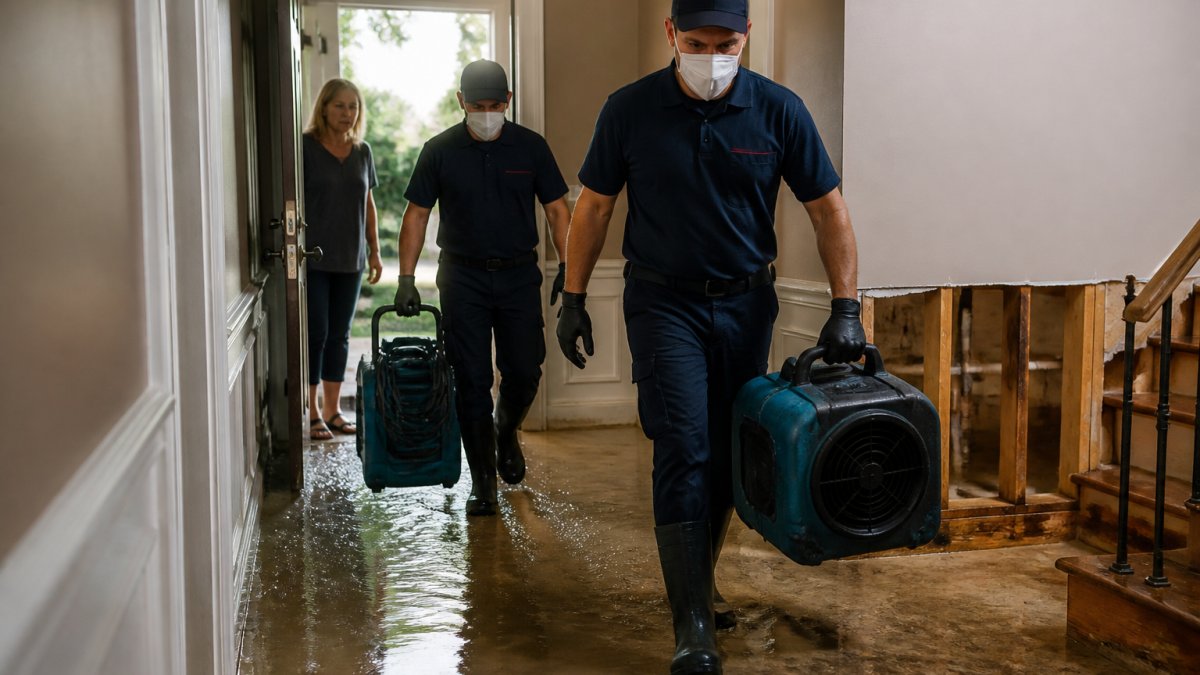
When your home is filling with water, the local vs national restoration decision feels less like a strategy question and more like a race against mold. Disaster Services has walked Greater Houston homeowners and property managers through that race hundreds of times, and the answer usually surprises people: the size of the company matters far less than the distance to your door.
Local vs national restoration comes down to who can physically reach your property first, who knows your insurance market, and who will still be answering the phone on day 30. A national chain may own more trucks nationwide, but those trucks are not parked in your county.
Below, we break down how to choose a restoration company, what response time really means, and where each option wins and loses.
How to Choose a Restoration Company That Fits Your Property and Claim
Start with three filters: response time, claim experience, and scope of work. A company that passes all three can handle your job from the first wet-vac to the final coat of paint.
Here is the short list of what to check before you sign anything:
- Response window in writing. Ask for the guaranteed arrival window, not a vague "as soon as possible."
- Insurance fluency. The team should speak your adjuster's language and document losses the way carriers expect.
- Full-scope capability. Water extraction, structural drying, smoke remediation, mold work, and rebuild under one contract.
- Licensing and insurance. Ask for proof before crews enter your property.
- Local knowledge. Familiarity with your area's flood patterns, building codes, and carrier habits saves days.
Business owners comparing options should also plan the response before disaster strikes. Our emergency disaster planning guide for businesses walks through that preparation step by step.
Local Restoration Companies: Strengths and Trade-Offs
Local firms win on speed and accountability. A locally owned team typically lives in the same metro, knows which neighborhoods flood first, and can often have a crew on site faster than a chain dispatching from a regional hub.
Disaster Services is locally and family owned and operated, with 24/7 emergency response across the Greater Houston area. That structure means the person who answers your call at 2 a.m. is accountable to the same community they serve. We also provide a free visual inspection, so you can see what we see before committing to anything.
The trade-offs are real, though. A single-location company has finite crews, so a widespread event like a tropical storm can stretch capacity thin. National chains can pull resources from other regions during a surge. If your property is large or your loss is catastrophic, ask any local firm directly how they handle overflow demand.
Best for: homeowners and small commercial owners who want fast arrival, direct communication, and a team that knows the local claim landscape.
Skip if: your loss spans multiple states or requires a national account program your carrier mandates.
Here is how local firms stack up against the trade-offs the article describes. For a closer look at what a local team's work involves, see this step-by-step guide to commercial water damage restoration.
| Aspect | Local restoration companies | Note |
|---|---|---|
| Response speed | Crew often on site faster than a chain | Team lives in the same metro |
| Accountability | Call answerer serves the same community | Locally and family owned and operated |
| Availability | 24/7 emergency response across Greater Houston | Free visual inspection offered |
| Capacity | Finite crews; widespread events stretch capacity thin | National chains can pull resources from other regions |
| Best for | Homeowners and small commercial owners | Want fast arrival and direct communication |
| Skip if | Loss spans multiple states | Or carrier mandates a national account program |
National Restoration Chains: Strengths and Trade-Offs
National chains bring scale, standardized process, and deep carrier relationships. Their playbook is consistent, and many hold preferred-vendor agreements with large insurers, which can simplify approval for big commercial losses.
What most people miss is the dispatch gap. A national brand's nearest office may be a county or more away, and during a regional disaster, that office is fielding hundreds of calls at once. You may get a call center, a case number, and a wait.
Standardization cuts both ways. Uniform process means predictable documentation, but it can also mean a crew that follows a template rather than reading your specific building. Older homes with unusual construction often need judgment a rigid playbook does not allow.
Best for: large commercial portfolios and policyholders whose carrier requires a specific vendor network.
Skip if: you need crews on site within hours and direct access to the decision-maker.
Restoration Company Response Time: What the First Few Hours Decide
Restoration company response time is the single biggest factor in how much damage you ultimately pay for. Water spreads through wall cavities and flooring within hours, and mold can begin colonizing damp materials in as little as a day or two under the right conditions, according to EPA guidance on mold and moisture.
That is why the first few hours matter more than the brand on the truck. A crew that arrives in hour two can often dry materials in place. A crew that arrives on day three is more likely to be tearing out drywall and replacing flooring.
Ask every company for a concrete arrival window and a written scope before work begins. For a closer look at what fast response should look like in practice, see our breakdown of emergency restoration response time expectations.
Questions to Ask a Restoration Company Before You Sign
The right questions separate a professional operation from a call center with a clipboard. Ask these before anyone touches your property:
- What is your guaranteed arrival window, and what happens if you miss it?
- Who is my single point of contact from start to finish?
- How do you document the loss for my insurer, and can I see a sample report?
- Will you handle the rebuild, or will I need separate contractors?
- How do you prove what you find during inspection, including mold?
- What does your contract exclude, and who pays for those items?
- Are your technicians licensed and insured, and can I see proof?
A company that answers these clearly and in writing is a company worth trusting. Vague answers are your signal to keep looking.
Restoration Company Insurance Claims: Who Handles the Paperwork
The best restoration company insurance claims process is one where the restoration team works directly with your adjuster, documents everything to carrier standards, and keeps you informed at each stage. You should not be the messenger between your contractor and your insurer.
At Disaster Services, comprehensive insurance claims assistance is part of the job. We photograph and document losses, provide the scope and moisture readings your adjuster needs, and communicate directly with the carrier so you are not translating between two parties. That does not replace your adjuster's judgment, but it removes the coordination burden from your plate.
Before you choose a company, confirm whether emergency water extraction is covered under your policy. Our guide on whether emergency water extraction is covered by insurance explains what to check. And if a claim does get denied, our walkthrough on how to handle an insurance claim denial gives you a clear path forward.
Schedule Your Free Inspection With a Local Restoration Team
Choosing between local and national restoration is really a question about who shows up, who documents the loss properly, and who stays accountable through the rebuild. When water is spreading and mold is a ticking clock, proximity and direct communication win.
Disaster Services offers 24/7 emergency response, a free visual inspection, licensed and insured technicians, and full-scope restoration from extraction through rebuilding, all handled by a locally owned team that knows this area's flood patterns and insurance landscape. You will not be handed off to a call center or left coordinating five contractors.
Get started with Disaster Services and put a crew on your property before the damage spreads.
Frequently Asked Questions
What is the difference between a local restoration company and a national franchise?
A local restoration company is owned and operated in your area, so crews and equipment are usually nearby and decisions are made on site. A national franchise follows corporate processes and may pull crews from other regions during a large storm. The practical difference shows up in response time, who handles your insurance claim, and whether the owner is accountable to your community. Ask each company where its crews stage from and who your point of contact will be.
Does a restoration company need to work with my insurance provider?
You are not required to use an insurer's preferred vendor. Most policies let you hire any licensed restoration company, though your insurer may ask for documentation. When comparing local vs national restoration, ask how each handles restoration company insurance claims: do they photograph damage, provide moisture readings, and send itemized estimates the adjuster accepts? A company that documents thoroughly and communicates with your adjuster reduces the chance of a disputed or denied claim.
What should I ask before hiring a water damage restoration company?
Ask for proof of licensing and insurance, the response time guarantee in writing, and whether they handle mitigation and rebuilding or subcontract part of the job. Request moisture readings and photos of what they find so you can verify the scope. Confirm who manages subcontractors and who communicates with your adjuster. These questions to ask a restoration company separate firms that own the whole process from those that hand off pieces to others.
Are national restoration companies more expensive than local companies?
Pricing depends on the scope of damage, materials, and your policy, not on whether the company is local or national. National chains may add corporate overhead and travel costs during storm surges, while local firms often have lower overhead. Rather than assume, request an itemized estimate, compare what each includes, and confirm how they bill your insurer. For a specific quote on your property, contact a local team for a free inspection.