 how-to
Emergency Restoration Response Time Expectations
Table of Contents
- What Emergency Restoration Response Time Actually Means
- Industry Standards for Emergency Water Damage Response Time
- Factors That Influence How Fast a Crew Reaches You
- Immediate Property Damage Mitigation Steps to Take While You Wait
- How to Verify a Restoration Company Before They Arrive
- Documenting Damage for Your Insurance Claim
- Conclusion
- Frequently Asked Questions
Last Updated: September 20, 2026
What Emergency Restoration Response Time Actually Means
Emergency restoration response time is the interval between your first call for help and a qualified crew arriving at your property, ready to stop the damage from spreading. The faster a certified team reaches you, the less water soaks into drywall, the less smoke settles into insulation, and the smaller your final repair bill tends to be.
Here's the part most guides get wrong: the timer doesn't start when the truck pulls up. It starts the moment the damage begins.
The Clock Starts Before You Call
Water keeps moving after the leak stops. It wicks up walls, seeps under flooring, and feeds mold that can take hold within a day or two. Every hour you spend searching for a phone number is an hour the damage gets worse.
So the real response window includes your own reaction time. A company that answers at 2 a.m. and dispatches immediately beats a company that opens at 9 a.m. every time.
That's why FEMA's guidance on returning home after a disaster tells property owners to document conditions and act quickly rather than wait for perfect information.
Industry Standards for Emergency Water Damage Response Time
The restoration trade doesn't publish one universal stopwatch number, but it does operate on a set of widely shared expectations. Knowing the tiers helps you judge what a dispatcher tells you on the phone instead of accepting whatever sounds fast.
A common pattern across established firms looks like this:
- Emergency call answering: within 1 to 2 rings, 24 hours a day, 365 days a year. If you reach a voicemail after hours, that's a red flag.
- Dispatch confirmation: within 15 to 30 minutes of your call, with a technician name and an estimated arrival window.
- On-site arrival (standard conditions): typically 1 to 4 hours for water, fire, and smoke losses in a metro service area.
- On-site arrival (catastrophic or regional event): 4 to 12 hours, sometimes longer when a single storm generates hundreds of simultaneous calls.
- Mitigation started (water extraction or board-up): within 1 to 2 hours of arrival for active water intrusion.
- Structural drying begun: within 24 to 48 hours of the loss, per the IICRC S500.
A service level agreement, or SLA, is a written promise about how fast a company will respond. Ask for it before you sign anything. A real SLA names a number, not 'as soon as possible.'
What the IICRC S500 Says About the First 24 Hours
The IICRC S500 is the standard guide the restoration trade follows for water damage. It stresses that drying should begin as soon as possible, because mold and structural damage accelerate after the first 24 to 48 hours. The standard also separates three categories of water (clean, gray, and black) and four classes of loss based on how much of the structure is wet, both of which change how long mitigation takes.
You don't need to read the whole document. Just know that any company worth hiring will talk about the first 24 hours like it matters. If they shrug it off, keep looking.
Why Response Time Affects Your Insurance Claim
This is the angle most guides skip: rapid response doesn't just save your drywall, it strengthens your claim. Adjusters evaluate whether the policyholder took reasonable steps to mitigate further damage. A documented arrival time, a written scope of work, and moisture readings taken on day one give your adjuster a clean timeline. Gaps in that timeline are where disputes start.
Ask the crew to note their arrival time on the work authorization and to photograph the initial moisture readings. Those two data points anchor everything that follows.
Factors That Influence How Fast a Crew Reaches You
Response time isn't one fixed number. It swings based on where you are, what the weather is doing, and when you call. Understanding these variables helps you set realistic expectations and plan ahead.
Geography, Weather, and Time of Day
A crew based 15 minutes away will usually beat one dispatched from across the metro. During a major storm, every restoration company in the region gets flooded with calls at once, and even the best teams get stretched.
Time of day matters too. A burst pipe at noon is easier to reach than one at midnight during a freeze, when roads are icy and demand spikes.
A few things that push arrival times longer:
- Severe regional storms that overwhelm local crews
- Remote or hard-to-access properties
- Rush-hour traffic on major routes
- Holidays and overnight calls
Immediate Property Damage Mitigation Steps to Take While You Wait
Immediate property damage mitigation means the quick actions you take to limit harm before the pros arrive. Done right, these steps protect your health, your belongings, and your insurance claim.
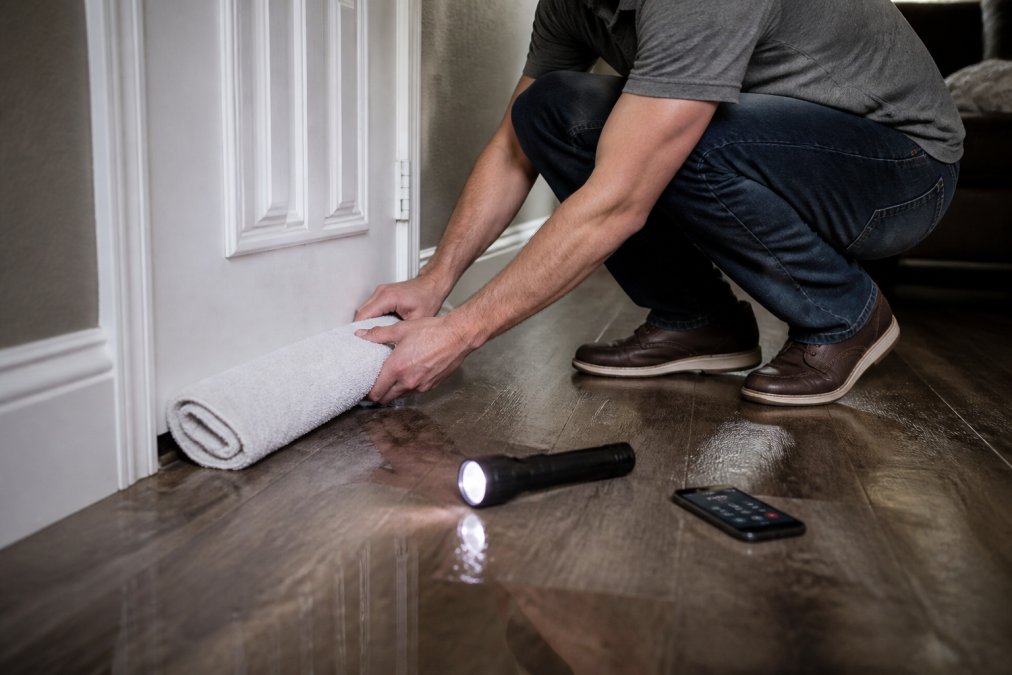
Start with safety, then slow the damage. Don't wade into standing water near outlets, and never touch electrical panels if the area is wet.
Pre-Arrival Safety Checklist
Work through this list while you wait:
- Shut off the water supply if a pipe is leaking
- Cut power to flooded rooms at the breaker, only if you can reach it safely
- Move furniture and valuables off wet floors
- Prop up wet upholstery and drape fabrics to dry
- Open windows to improve airflow if the weather allows
- Keep children and pets out of affected areas
- Photograph everything before you move it
How to Verify a Restoration Company Before They Arrive
Verification takes a few minutes and can save you thousands. A legitimate firm will happily answer pointed questions over the phone while their crew is en route, and will point you to public records you can check yourself. This is the step most homeowners skip, and it's the one that separates a real restoration contractor from a storm-chaser who appeared in your driveway.
The Three Checks You Can Run While You Wait
1. License and registration. Most states require restoration and mold remediation contractors to hold a specialty license or registration, and many require a separate mold remediation credential. Ask for the license number, then look it up on your state's contractor licensing board website. The lookup takes about 60 seconds and confirms the name, status, and expiration date.
**2.
Questions to Ask Before Anyone Starts Work
- Are your technicians licensed and insured, and can you send the certificate today?
- Do you provide a free visual inspection and a written scope of work?
- Will you document the damage with photos and moisture readings for my insurance claim?
- Can you give me a written estimate before work begins, and what does your change-order process look like?
- Who is my single point of contact from start to finish?
Credentials matter because restoration touches your structure, your air quality, and your wallet.
Documenting Damage for Your Insurance Claim
Good documentation is the difference between a smooth claim and a fight. Your insurer wants proof of what was damaged, when it happened, and how much it will cost to fix.
Here's how to build a strong record:
- Take wide photos and close-ups of every affected room
- Keep a written log of dates, times, and who you spoke with
- Save receipts for hotels, meals, or supplies if you're displaced
- Don't throw away damaged items until your adjuster says so
Conclusion
The hardest part of a disaster is the waiting, and the uncertainty that comes with it. You want to know someone is coming, that they're qualified, and that they'll help with your claim.
Frequently Asked Questions
What is considered an industry-standard response time for emergency water damage?
The IICRC S500 standard recommends that restoration professionals arrive on-site within 24 hours of a water damage event. The first 24 to 48 hours are critical because mold can begin growing on wet materials within that timeframe. A qualified crew should begin moisture extraction and drying equipment setup on the same day they arrive.
What factors influence how quickly a restoration team can arrive on-site?
Several variables affect on-site arrival. Distance from the dispatch center, traffic conditions, and weather events like hurricanes or flooding can delay crews. Time of day matters too, as overnight calls may have fewer technicians available. Companies with a local presence and a service level agreement (SLA) for emergency response typically reach properties faster.
What should I do while waiting for the restoration crew to arrive?
Start with safety. If water is near electrical outlets or standing water is deep, turn off power at the breaker if you can do so safely. Document everything with photos and video for your insurance claim. Move valuables and furniture away from wet areas if it is safe. Do not use a household vacuum to remove water. Place towels or barriers to limit spreading, and keep children and pets out of affected rooms.
How do I verify a restoration company is qualified before they arrive?
Ask for their license number and insurance certificate. Check that technicians hold IICRC certifications, which show training in water damage and mold remediation standards. Request a written scope of work and confirm they will document the damage assessment with moisture readings you can see. A reputable company provides these details upfront and does not pressure you to sign anything before the work is explained.