 how-to
How to Book Commercial Property Restoration in Houston
Table of Contents
- What to Do in the First Hour After Commercial Property Damage
- How to Vet and Book a Commercial Property Restoration Company
- Navigating the Commercial Restoration Insurance Claim Process
- What Drives Commercial Water Damage Restoration Cost
- Building a Commercial Property Disaster Recovery Plan
- Minimizing Business Downtime During Restoration
- Frequently Asked Questions
Last Updated: September 18, 2026
What to Do in the First Hour After Commercial Property Damage
The first hour after commercial property damage determines how much of your building you save and how much your insurer pays. For any property manager trying to book commercial property restoration houston-area crews under pressure, that hour is your leverage.
Here's the sequence that works:
- Stop the source. Shut off the water main, gas line, or electrical breaker feeding the damaged zone. Never enter standing water near live panels.
- Document everything before you touch it. Photos, video, timestamps. Your adjuster will ask for this, and gaps get disputed.
- Call your insurer's claims line and open a claim number. You need that number before any contractor starts work.
- Call a restoration company that answers 24/7. Water keeps migrating through walls and ceilings while you wait.
- Move salvageable inventory and records to a dry, secure area. Wet paper and electronics degrade within hours.
How to Vet and Book a Commercial Property Restoration Company
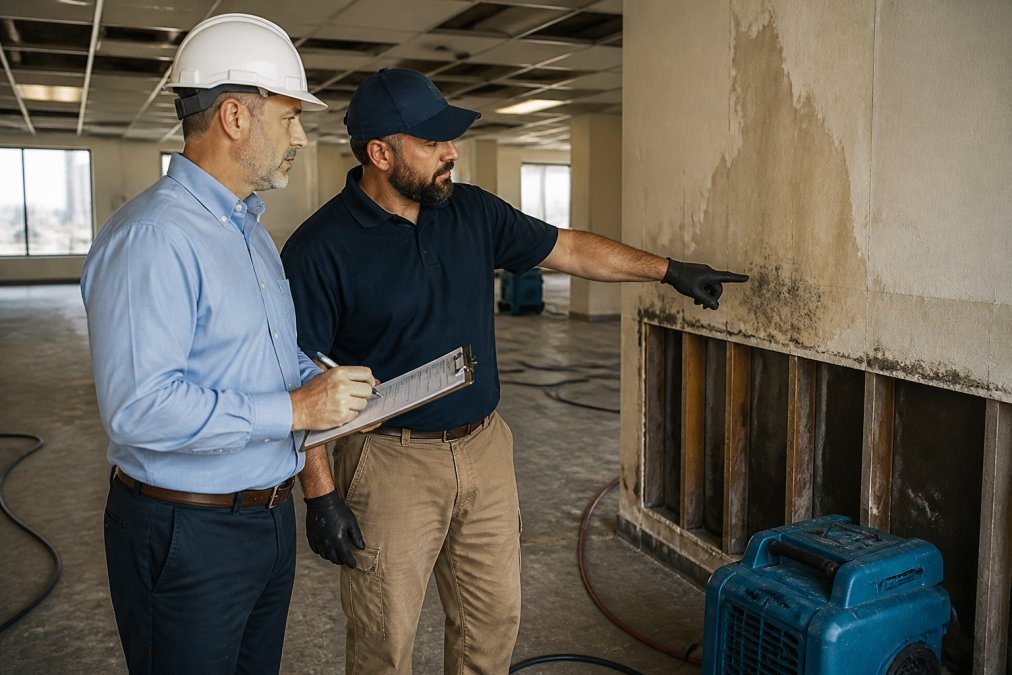
Vetting a restoration company comes down to four things: certifications, response time guarantees, insurance documentation, and whether they handle the whole job or subcontract half of it. Get answers in writing.
Certifications and Credentials That Matter
- IICRC Water Restoration Technician (WRT) for water damage crews
- IICRC Applied Structural Drying (ASD) for drying and dehumidification leads
- IICRC Mold Remediation Technician for any mold work
- State licensing and general liability insurance with certificates you can verify
- Workers' compensation coverage for anyone entering your building
Questions to Ask Before You Sign
Ask these before you commit, in writing:
- What is your guaranteed on-site response time?
- Will your own employees do the work, or will you subcontract?
- How do you document moisture readings and drying progress?
- Will you communicate directly with my insurance adjuster?
- What does your scope of work exclude?
That last question matters most. Exclusions are where budgets blow up.
Navigating the Commercial Restoration Insurance Claim Process
The commercial restoration insurance claim process moves faster when you treat documentation as the job. Most delays trace back to missing evidence, not insurer reluctance.
Documentation That Protects Your Claim
- Timestamped photos and video of every affected area before work begins
- Daily moisture readings and drying logs
- Itemized inventory of damaged contents, with replacement values
- Contractor invoices, equipment rental records, and disposal receipts
- Written communication with your adjuster, saved and dated
A restoration partner who handles claim documentation directly removes a huge administrative load. FEMA's guidance on commercial property disaster documentation outlines how thorough records speed up federal and private claims alike.
What Drives Commercial Water Damage Restoration Cost
Commercial water damage restoration cost depends on water category, square footage, materials, and how long the water sat before extraction. No honest contractor quotes over the phone; any bid without an on-site inspection is a placeholder.
The variables that move the price:
| Cost Driver | Why It Matters |
|---|---|
| Water category | Clean water costs least; sewage and floodwater require biohazard protocols, PPE, and disposal |
| Affected square footage | Larger areas need more drying equipment and longer run times |
| Material type | Drywall and carpet often need removal; concrete and metal can dry in place |
| Time since damage | Mold can begin colonizing wet materials within 24 to 48 hours |
| Building access | Multi-floor or restricted-access spaces slow equipment deployment |
| Contents and inventory | Electronics, files, and specialized equipment add pack-out and restoration line items |
| After-hours work | Night and weekend mobilization carries premium labor rates |
How Restoration Estimates Are Actually Built
A legitimate commercial estimate is assembled from four cost buckets, letting you sanity-check any bid:
- Labor, billed by the hour or by the day, scaled to crew size and the certifications required (a mold job needs different technicians than a clean-water extraction).
- Equipment, air movers, dehumidifiers, negative air machines, and moisture meters are typically billed per unit per day, so drying duration directly drives this line.
- Materials, antimicrobials, disposable PPE, plastic containment, replacement drywall, insulation, and flooring.
- Disposal and specialty services, dumpster rental, biohazard transport, document drying, and electronics restoration.
How to Budget Without Surprises
Request a written, line-item scope before work starts. Ask what triggers a change order, and require written approval before any cost increase. Set aside a contingency for hidden damage, since opening a wall almost always reveals more than the initial inspection showed, build that buffer into capital planning, not your emergency fund.
Three habits keep budgets from drifting:
- Get the drying goal in writing. Ask for the target moisture content for each material type, and for the daily readings that prove you reached it. Equipment that runs three extra days because no one defined "dry" is pure waste.
- Cap equipment rental in the contract. If the scope says "dry until dry," you have no ceiling. Ask for a projected equipment-day count and a process for approving overages.
- Separate restoration from replacement. Restoration saves the existing assembly; replacement tears it out and rebuilds. Make sure your estimate labels which is which, because insurers often reimburse them differently.
What Insurance Typically Covers vs. What You Pay
Most commercial property policies cover repair or replacement of damaged building materials and contents, plus mitigation to prevent further damage. What they frequently do not cover, or cover only partially:
- Betterment and code upgrades, if current building codes require upgrades during reconstruction that did not exist when the building was built, that gap is often on you.
- Business income losses beyond your policy's period of restoration.
- Pre-existing conditions, deferred maintenance, prior leaks, or old mold that predates the loss.
- Landscaping, signage, and exterior items unless specifically scheduled.
Building a Commercial Property Disaster Recovery Plan
A commercial property disaster recovery plan names who does what, in what order, when a property is damaged, so decisions get made before the emergency. The real value is the business continuity layer underneath, the part that keeps revenue flowing while the building is rebuilt.
Disaster Recovery vs. Business Continuity: Know the Difference
These terms get used interchangeably, but they solve different problems:
- Disaster recovery is about the building, stopping the damage, documenting it, and restoring the physical asset.
- Business continuity is about the operation, keeping your tenants, customers, and revenue alive while the building is offline.
The Five Components of a Working Plan
Build yours around five components:
- Contact tree: insurer, restoration partner, key staff, utility providers, and tenants, with after-hours numbers, not just office lines
- Asset inventory: photographs, serial numbers, and values for critical equipment, plus a copy stored off-site or in the cloud
- Shutoff locations: labeled water, gas, and electrical panels with photos, so anyone on site can act without hunting
- Communication plan: how you notify tenants, staff, and customers, including pre-drafted templates for the first 24 hours
- Recovery priorities: which operations must resume first, and where, the sequence that protects your largest revenue stream
The Business Continuity Layer Competitors Skip
Once the five components exist, add the continuity layer, what separates a plan that satisfies an auditor from one that protects your income.
Test It, Then Test It Again
A plan that has never been exercised is a document, not a capability. Run a tabletop exercise annually: pick a scenario (sprinkler discharge on a Saturday night, roof failure during a storm), walk the team through the first hour, and time how long it takes to reach every name on the contact tree. Every exercise surfaces at least one outdated number or missing key.
Minimizing Business Downtime During Restoration
Downtime during restoration is often more expensive than the damage itself. Lost revenue, displaced tenants, and interrupted contracts add up while crews work.
Frequently Asked Questions
What is the first step in commercial property restoration?
The first step is a rapid damage assessment. Call a licensed restoration company immediately, then document everything with photos and video before anything is moved. Shut off the water source if safe, and avoid entering areas with structural damage. A certified crew will perform moisture mapping, thermal imaging, and a property damage assessment to determine the scope. Early action prevents mold growth, which can start within 24 to 48 hours.
How do I choose a commercial restoration company?
Look for IICRC certified technicians, 24/7 emergency response, and a track record with commercial properties. Ask about their emergency response time, whether they handle the full scope from water extraction through reconstruction services, and how they manage insurance claim documentation. A locally owned and operated team often knows the Greater Houston market, local permitting, and regional weather risks better than a national chain.
Does commercial property insurance cover restoration services?
Most commercial property policies cover sudden and accidental damage from burst pipes, storms, or fires, including water extraction, structural drying, dehumidification, and reconstruction services. Coverage depends on your specific policy. Your restoration company should provide detailed documentation, moisture readings, and photo evidence to support the commercial restoration insurance claim process. Review your policy exclusions and deductibles early so you know what to expect.
How long does commercial water damage restoration take?
Timelines vary by damage extent and property size. Water extraction and structural drying typically take 3 to 5 days, but larger commercial spaces may need longer. Mold mitigation, reconstruction services, and building envelope repair can add weeks. A commercial property disaster recovery plan helps you set realistic expectations and communicate downtime to tenants and stakeholders. Ask your restoration provider for a written project timeline before work begins.