 ultimate-guide
Why Professional Smoke Cleaning Matters for Your Home
Table of Contents
- Why Professional Smoke Cleaning Matters More Than You Think
- How Smoke Residue Travels Through Your Home
- The Health Effects of Smoke Residue on Your Family
- Why DIY Cleaning Often Fails to Remove Smoke Odor
- What the Fire Damage Restoration Process Actually Involves
- How Long Does Smoke Remediation Take?
- Material-Specific Cleaning Protocols and Chemical Safety
- Insurance Claims, Documentation, and Post-Cleaning Maintenance
- Frequently Asked Questions
Last Updated: October 2, 2026
Why Professional Smoke Cleaning Matters More Than You Think
Smoke damage rarely stops where the flames did. Long after a fire is out, smoke residue keeps moving through a home, settling into walls, insulation, furniture, and ductwork, which is why professional smoke cleaning matters far more than most homeowners expect. This guide explains how residue travels, what it does to your health and your property, and what proper remediation actually involves.
How Smoke Residue Travels Through Your Home
Smoke residue is the film of soot, ash, and chemical byproducts left behind after combustion, and it does not stay in the room where the fire started. Hot smoke rises, cools, and then spreads through every connected space, including closets, cabinets, and the cavities inside your walls.
Smoke infiltration follows three paths:
- Pressure-driven spread: Smoke pushes through gaps around doors, outlets, and pipe penetrations.
- HVAC circulation: Return air carries particulate matter into ducts, then into every served room.
- Surface adsorption: Porous materials like drywall, fabric, and wood absorb odor compounds over time.
The Health Effects of Smoke Residue on Your Family
Most homeowners judge smoke risk by smell. That is the wrong instrument. The compounds that make post-fire residue hazardous are largely odorless at the concentrations that matter, and they persist long after the visible soot is wiped away. Understanding what is actually in the residue is the difference between a cosmetic cleanup and a real remediation.
What smoke residue is made of:
- Fine and ultrafine particulate matter: Combustion produces particles in the PM2.5 range and smaller. These are small enough to bypass the body's upper-airway defenses and reach deep lung tissue, and the smallest fractions can cross into the bloodstream.
- Volatile organic compounds (VOCs): Formaldehyde, benzene, toluene, and acrolein are common combustion byproducts. They off-gas from porous materials for weeks, which is why a room can smell "clean" and still be releasing irritants.
- Polycyclic aromatic hydrocarbons (PAHs): A family of compounds formed during incomplete combustion. Several individual PAHs are classified as probable human carcinogens, and they bind tightly to soot and to soft surfaces like upholstery and carpet.
- Acidic residues: Soot from many fires is acidic. Left on metal, electronics, and stone, it keeps etching and corroding surfaces until it is neutralized, not just wiped.
Who faces the highest risk:
- Children, whose lungs are still developing and who breathe more air per pound of body weight
- Older adults, especially those with existing heart or lung conditions
- Anyone with asthma, COPD, or allergies, whose symptoms can flare from exposures that others barely notice
- Pets, particularly birds, which are highly sensitive to airborne irritants
Symptoms that often appear gradually:
- Persistent cough, headaches, or sinus irritation
- Worsening asthma or allergy symptoms indoors
- A metallic or acrid taste that returns after cleaning
- Fatigue and dizziness in enclosed rooms
Why DIY Cleaning Often Fails to Remove Smoke Odor
Household cleaners remove surface soot. They do not remove odor, because odor is not on the surface; it is inside the material. This is the single biggest reason DIY smoke cleaning fails, and it is why the smell returns days or weeks after you think you are done.
The Limits of Household Cleaners on Porous Materials
Porous materials such as drywall, unsealed wood, carpet, upholstery, and insulation trap soot and odor compounds inside their structure. A sponge cannot reach them. Neither can a spray bottle.
What the Fire Damage Restoration Process Actually Involves
The fire damage restoration process is a staged sequence: assess, contain, remove, neutralize, and verify. Skipping any stage leaves residue behind, which is why a professional crew works from a written scope rather than a visual once-over.
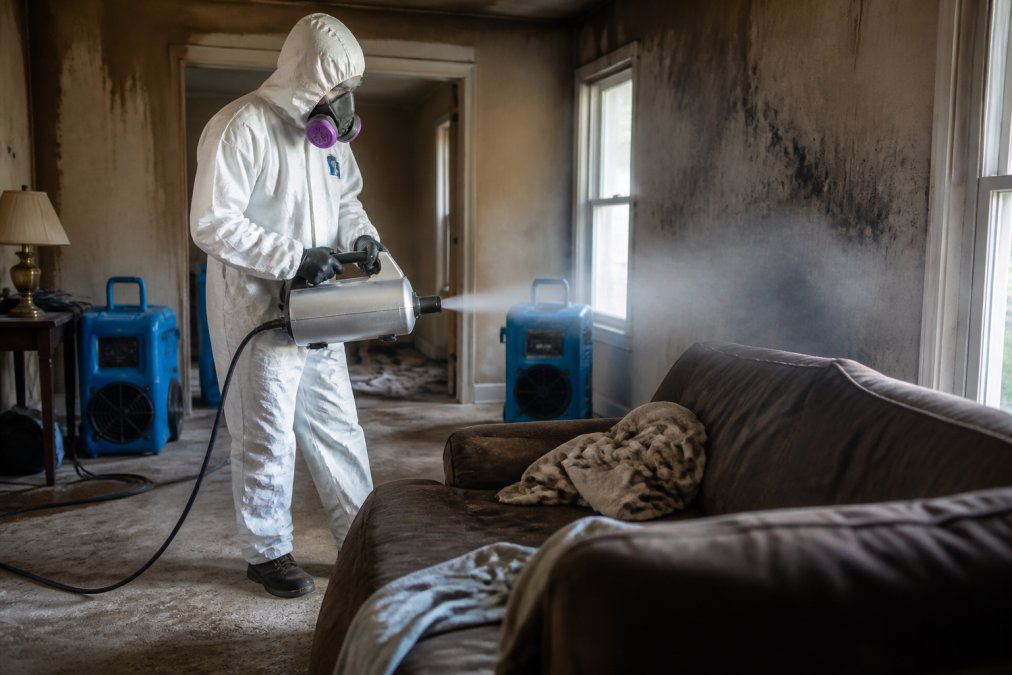
The typical sequence looks like this:
- Damage assessment: Map the spread of smoke infiltration, test residue on multiple surfaces, and document pre-loss condition for your claim.
- Containment: Seal off affected areas to prevent cross-contamination into clean rooms.
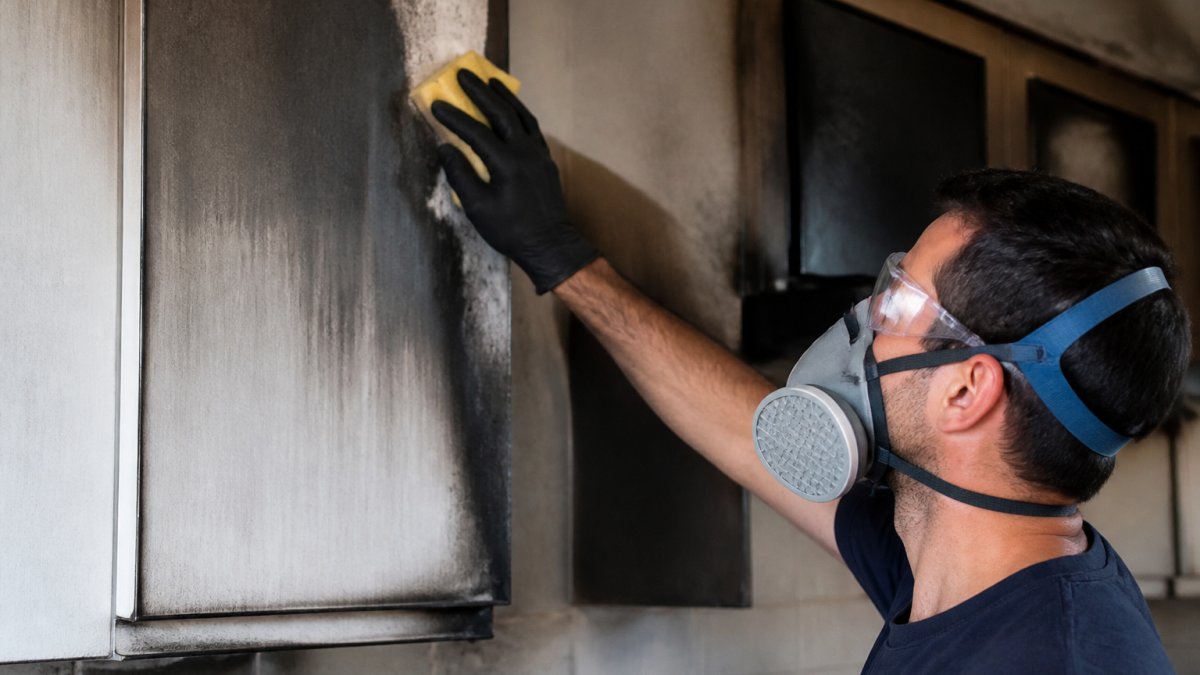
- Dry removal: Use HEPA filtration vacuums to capture soot particles without spreading them.
- Surface remediation: Clean and treat each material according to its type and porosity.
- Odor neutralization: Deploy thermal fogging, hydroxyl generators, or ozone treatment where appropriate.
- HVAC decontamination: Clean ductwork and components so the system stops redistributing residue.
- Verification: Confirm air quality and residue testing results before closing the job.
Surface Remediation vs. Deep Odor Neutralization
Surface remediation removes visible residue from hard, non-porous surfaces. Deep odor neutralization treats the source inside porous materials, and it is the step that actually eliminates the smell.
How Long Does Smoke Remediation Take?
Most residential smoke remediation takes two to five days, though the timeline depends on how far smoke traveled and how long it sat before treatment began. A contained kitchen fire with fast response often finishes faster; a fire that ran through ductwork or sat for a week takes considerably longer.
What extends the timeline:
- HVAC decontamination, which adds a day or more on its own
- Porous materials that need encapsulation or replacement
- Structural damage requiring rebuild work after cleaning
- Waiting on insurance approval before work can proceed
Material-Specific Cleaning Protocols and Chemical Safety
Every material needs its own protocol, and using the wrong one causes permanent damage. Drywall, hardwood, tile, and fabric all respond differently to moisture, pH, and agitation, so a single all-purpose approach is a recipe for ruined finishes.
Matching method to material:
| Material | Cleaning Method | Watch Out For |
|---|---|---|
| Painted drywall | Dry sponge, then sealed | Water spreads stains |
| Hardwood | Dry removal, then wood-safe cleaner | Excess moisture warps boards |
| Tile and stone | pH-appropriate cleaner | Acidic cleaners etch stone |
| Carpet and upholstery | HEPA vacuum, then hot extraction | Agitation sets odor deeper |
| Metal fixtures | Gentle polish after cleaning | Abrasives scratch plating |
| Ductwork | Mechanical cleaning plus HEPA | Loose soot re-enters air |
Insurance Claims, Documentation, and Post-Cleaning Maintenance
Insurance claims are won or lost on documentation, and this is the part most homeowners handle worst. Your adjuster is not on site, did not see the fire, and is working from whatever file you build. A thin file gets a thin settlement. A thorough one gets the scope of work your home actually needs.
Documentation checklist, build this file before cleanup begins:
- Pre-loss condition evidence. Photos and video of every room, closet, and cabinet before anything is moved or cleaned. Include wide shots that show room layout and close-ups of affected surfaces.
- Dated damage photos. Shoot the same angles daily as conditions change. Soot staining, corrosion on metal, and odor migration into distant rooms are all evidence of spread.
- Residue testing results. A written assessment that identifies residue type and the surfaces affected. Protein residue from kitchen fires is nearly invisible but leaves a strong odor and is often missed in DIY assessments.
- A written scope of work. The restoration crew's itemized plan, what gets cleaned, what gets encapsulated, what gets replaced, and what gets tested at the end.
- Receipts for emergency expenses. Hotel stays, meals, pet boarding, and any emergency board-up or tarping. These often fall under additional living expenses (ALE) coverage.
- Communication log. Dates, names, and summaries of every call with your adjuster or agent. If a dispute arises, this log is your record.
- Change HVAC filters on schedule. After a fire, switch to a higher MERV rating (MERV 11 to 13 is a common target for smoke-affected homes) and replace filters more often for the first several months. Check with your HVAC technician first, some residential systems cannot handle the airflow restriction of high-MERV filters.
- Control indoor humidity. Odor compounds trapped in porous materials can reactivate when humidity rises. Keeping indoor relative humidity in the 30 to 50 percent range reduces that risk.
- Re-test any room where you notice a returning smell. A returning odor is a signal that residue remains, not a reason to repaint.
- Do not paint or seal surfaces until remediation is verified complete. Sealing over residue traps the odor and forces a full strip-and-redo later.
- Schedule a follow-up air quality check. A short re-test a few weeks after the job closes catches anything that was missed before it becomes a bigger problem.
Smoke damage is a chemistry problem, not a cleaning problem. The job is done when residue testing and air quality results say so, not when the room looks clean, and the paper trail you build along the way is what gets the claim paid.
Frequently Asked Questions
Why is professional smoke cleaning necessary after a fire?
Smoke residue contains soot particles and volatile organic compounds that penetrate drywall, insulation, and upholstery. Household cleaners only reach the surface, so odor returns within weeks. Professional smoke cleaning uses HEPA filtration, thermal fogging, and hydroxyl generators to neutralize odor molecules at the source. It also prevents cross-contamination, where residue spreads to unaffected rooms through foot traffic and your HVAC system.
What are the health effects of smoke residue left untreated?
Lingering smoke residue releases particulate matter and toxic byproducts that can irritate your eyes, throat, and lungs. People with asthma, allergies, or heart conditions face higher risk. Long-term exposure to soot particles has been linked to respiratory issues and worsened indoor air quality. Children and older adults are especially vulnerable. If you smell smoke weeks after a fire, the residue is still off-gassing and should be addressed by a certified restoration team.
How long does smoke remediation take for an average home?
Most residential smoke remediation takes two to five days, depending on the size of the home and how far smoke infiltrated. A contained kitchen fire might need two to three days, while a larger fire affecting the HVAC system can stretch to a week or more. The fire damage restoration process includes damage assessment, air scrubbing, surface remediation, and odor neutralization. Your contractor should give you a timeline after the initial inspection.
Can you remove smoke smell from walls yourself?
You can wipe down non-porous surfaces with a degreaser, but walls, ceilings, and insulation absorb smoke like a sponge. Painting over residue traps odor rather than removing it, and it often bleeds back through. Without HEPA filtration and professional-grade equipment, you cannot pull soot particles out of porous materials. If the smell persists after two cleaning attempts, call a certified restoration company to assess the damage.